Showing posts with label Android. Show all posts

Monday, October 3, 2011

Amazon's Kindle Fire. Is it Worth $199?


Kindle Fire
It's official.  Amazon has a few new Kindles, and one is the color Android-based Kindle Fire. The press was stunned when the Fire's $199 price was announced.  The hardware specs are competitive but missing a few standard components.  Some estimate 5 million or so will be sold before the end of this year. The Fire isn't the first 7" tablet out there, and it isn't even the cheapest one. Walmart.com has a half dozen 7" tablets available for under $200. You can buy the Maylong 7" tablet for as little as $97.

Here are a few:
So what magic makes the press think Amazon's Fire will sell better than any of these?  Sure, most of these have worse specs than the Fire.  Yet many also have hardware features (Cameras, HDMI-out) the Fire doesn't include. All have WiFi.  All are touchscreen Android tablets.  All run apps including all of Amazon's apps. Lined up spec for spec the Fire doesn't glow for what it can do.  It blushes for what it doesn't do.

So what is the secret?   I'm blaming it on Respect.  Amazon, like Apple, has built up a reputation for treating customers well. They have both simplified the process of buying media and products from them. We respect Apple and we respect Amazon. They are both American originals. We surrender our beliefs to Apple in exchange for designful and productive devices we didn't know we needed. The press and Amazon fans have done the same concerning the Fire. I've pre-ordered mine out of the same respect.

Let's do a reality check though.   The Fire is a first generation device.  Remember the first wedge Kindle?   Original, but far from evolved. The second and later generations were better in every way.  My experience repeatedly demonstrates that 1st generation devices are poor investments. This is more often true for ground-breakers, and Amazon is a ground-breaker. Late comers/Followers can learn from the mistakes made by others.  I expect the second generation Fire to be thinner, faster, and have a few more features than this first gen Fire.  It may also be less expensive.  Previous Kindles have gotten cheaper each year since the first one came out at around $400.

So is the Kindle Fire a good investment?  I'm going to rate it a tentative "yes". From what I can tell the hardware is similar to the Blackberry Playbook. Made by the same manufacturer I'm expecting the Fire to be similarly well-made. The dimensions are a little different, but the details are very similar.  Each specification the Fire lists is equal to or better than the competition. A 1024 x 600 screen when many have 800 x 480 screens. Capacitive multi-touch when many have resistive single-touch input. A dual core processor when many have single core chips.  The Fire will have a liquid user interface (UI) and shouldn't stutter or pixelate displaying movies or photos. The screen will react instantly to your touch, and using it should become a mere extension of your thoughts.   I expect Amazon to do it right.  The Fire should delight the user. Should it not you can certainly expect the 2nd generation to.

Yes,  I believe the new Kindle Fire is worth $199.   The Blackberry Playbook and HTC Flyer are more capable tablets, and at $299 they are also priced proportionally correct given their additional features.  If you think you might want a Fire, don't wait. Reviews will be out before new orders are shipped and you can always cancel should you change your mind.

Comments are welcome.  Feel free to contribute.
4D


P.S.: If you enjoy my blog, please consider clicking on an Ad or two.  Thanks!

Sunday, March 6, 2011

Creative Zen Touch 2 with GPS. My Review.


Creative is now making an Android-based Zen media player.  I'm delighted to see more companies jumping on the android bandwagon. When the Zen Touch 2 (I'll referred to it as the T2) with GPS became available on their web site (you can also order them on Amazon.com) I ordered one.  Mine arrived 2/28/2011, and since then I've been going through it in detail, hoping to find what special touches Creative could add to Android, if any.  As of now,  I'm not sure they did anything beyond putting their name on this device.
Aesthetically the only interesting detail Creative added to an otherwise boring T2 is a faceted back derived from their Zen Mosaic.   Don't consider this player if you want to impress your friends with your stylish choices.  The nicest software touch they added was a quick graphic on boot-up advising you to "Touch the Sound of Perfection".  After that you get another annoying slide-to-unlock screen then a typical Android UI. 

What's in the Box?  In addition to the 8gb (only 4.1gb available) Zen Touch 2 you get:
Dimensions: 
  • 120mm x 69mm x 13mm, 122g.  
  • 4.72" x  2.72" x .5", 4.3oz
  • For comparison:
    • The Cowon D3 is 116.4mm x 64.2mm x 11.8mm, 120g.
    • The Archos 43 is 135.0mm x 65.0mm x 9.00 mm, 132g
OS: Android 2.1, with hints (no promises) that it may eventually be updated to 2.2.
Controls and Ports (held horizontally with the Home button on the right):
  • Power button (left end). Hold in to power the T2 on or off.  Tap to toggle just the screen off/on.
  • Volume +/- (top edge)
  • Search, Back, and Menu/List buttons (touch sensitive, to the right of the LCD screen)
  • HOME button (oddly a mechanical push button on the front face)
  • Speaker port (5/16" x 1/16" slot on back)
  • Camera Lens (on back)
  • Mini USB port (right end)
  • Headphone jack (right end)
  • Video output (Composite, uses headphone jack and custom cable)
  • MicroSD slot (bottom edge under a rubber pull tab)
  • Microphone (small hole on bottom edge, labeled by white microphone icon)
This Zen's media apps:
  • Music: The T2 will play music in these formats:  MP3, AAC, WMA9, FLAC, OGG, ADPCM, MIDI, WAV, and Audible.  I was shocked to discover there is no Equalizer. No Presets. No user settings.  I had to dig out my ancient Zen 4gb to see if this was Creative's pattern or not (it is NOT).   The audio output was powerful enough to easily drive my large Sennheiser HD595 headphones. No gapless playback though.   Just the basics it seems.  On the Now Playing screen you get a small album art view. Controls are all visible and active including List, Shuffle and Repeat buttons, as well as the typical Prev(Rewind when held)/Play(pause)/Next(Fast Forward when held) buttons. Info displayed includes a song length/position slider bar, artist, album, and song title. A long press on the last three brings up a Music/Browser Search window to find all songs or web info that matches the item touched. The Now Playing screen simply rearranges the same info for landscape or portrait view.  A tap on the T2's menu icon will bring up options for Party Shuffle, Add to Playlist, Delete, and Library.  With no Equalizer though the Music app gets a B.
  • Gallery (used for video and photos): Both Video formats supported include H.264, MPEG4, WMV9, and AVI video.  Photo types include JPG, BMP, and PNG.  My Touch 2 played WMV, AVI, and MP4 video files fine,  although those that weren't the same width/height ratio as the screen had no way to be stretched to fit the screen. All you get when playing videos is the standard video Rew/Play/Ffwd and a length/position slider bar. No info, no submenu options, nothing. Don't buy the Touch 2 for videos.  Video gets a C- from me.  The Photo capabilities are only a little more useful.  No swipe to the next photo.  You have to tap on the screen to get a next or previous triangle to tap on. You also get a zoom (magnifying) in/out bar, a share icon, and a delete icon. Tap Share to bring up options for Bluetooth Object Push and Email.  You can also double-tap on the screen for one step of zooming in. Once zoomed in it is easy to pan around the photo.  Using the magnifying bar there are 13 steps of zoom, which does a fine job of bringing up the tiniest details in a photo.   Tap the T2's menu button for a few more options including Rotate, Delete, Crop, Details, and More. More adds Show on Maps, Slideshow, Settings (for slideshow), and another Push Image by Bluetooth choice. Slideshow Settings are more complete than usual.  Where both Videos and Photo suffer is from the poor screen quality.  Photos get a B- from me for leaving out the easiest way to see the next photo.
  • FM Radio with RDS!  You need headphones plugged in to use the radio.  The Radio app will warn you to plug them in if they are not, and although the radio app will open it won't turn on without the headphones.  The app is fairly complete. You get a station slider bar, Off/On button, scan forward and back buttons, frequency up and down (in .05 steps) buttons, an add-to- presets (+) button, and a Presets List button which includes the AutoTune choice. If the station tuned to includes RDS info it will display above the frequency displayed. No HD-Radio reception. No option to delete a preset from the list that I could find. No recording of Radio that I could find. Radio will play in the background while you run other apps that don't have their own audio.  To turn it off you need to tap the power icon in the app, or run another program with its own audio (like Music). With no recording or preset delete I have to give FM Radio a B.
Other hardware features include:
  • Bluetooth - 2.1 EDR:  So far I've found it supports file transfer, stereo audio to headphone or speakers.  My bluetooth keyboards would pair but not connect. Audio quality over bluetooth to my Sony BT50s is on the better side of typical. All controls over media play worked both from the headset and the player.
  • WiFi - IEEE 802.11 b/g/n:  No problems connecting to my Dlink n-capable router. Signal strength is as good as on any other 802.11n device I've reviewed, no matter where in my house I wandered to.    
  • GPS: I'll need to find a GPS enabled app to give this a test.  Stay tuned.
  • Compass: Seems to work.  Found north just fine using a compass app.  Not sure how useful it will be, but am optimistic it will eventually come in handy.
  • Accelerometer: The UI and direction-sensitive apps react quickly when the T2 is rotated. Nothing else to test it with.  Another "stay tuned".
  • Camera:  The camera will take still photos at 1600 x 1200 (2mp) or 640 x 480 as JPGs. Video taken is MP4 (H.264) at 21fps and 360kbps, 640 x 480 pixels. Video doesn't play back very smooth.  The camera app is pretty complete, with white balance, quality, GPS (location) tagging, effects settings, crop and delete, etc.. No zoom to speak of.  No flash.  The lens is fixed-focus and cheap. It is also easily blocked by your finger when holding the T2 naturally.
Web Browser: Works best with mobile web pages.  The low resolution hinders usefulness on classic web pages. A double tap works as expected, stretching columns to fit the screen width. Panning and scrolling is responsive and smooth. I recommend using a stylus if you expect to be accurate tapping on tiny links. Settings include options to Add a bookmark, Find on Page, Select Text, Page Info, Share Page, Downloads, and page content settings.  You can choose from Text Size, Default Zoom, Text Encoding,   Open Pages in overview, Block Pop-up windows, Load images, Landscape only, Enable Javascript, Enable Plug-ins, Open in Background, and Set Home Page.  In addition there are privacy settings to Clear cache, Clear History, Accept cookies, Clear all cookie data, Remember form data, Clear form data, Enable location, Clear location access, Remember passwords, Clear passwords, Show security settings, and even more advanced options. With exceptions for the low-res screen The Web Browser is very complete. Almost a joy to use on the Touch 2. Web Browser earns an A.

UI:  The android UI will turn horizontal or vertical depending on how you hold the T2, but only 90 degrees one way. The screen is sensitive and very responsive, but graphics do not instantly react like those on an iPod Touch. There are only three home page screens.  This will prove limiting after you start adding apps.   You get just 4 widgets including an analog clock, bluetooth control (PureAndroidAudio),  Power Control, and Search.  You can add Widgets, Shortcuts, or Folders to any or all home screens.  You can also choose the wallpaper (background) from 10 included photos, your own photos, or 4 different colors.  You can adjust the brightness of the screen from Settings-Display or the Power Widget.   Viewing angles are decent in one axis and limited in the other, typical for the inexpensive LCD screen used.   Other than for the poor choice of screen the UI response is as good as any other android device I've reviewed. Limited pages and included apps/widgets lead me to giving UI a B-.
Conclusion:  For a device with so many hardware features it is a shame Creative went with such a poor screen. The Touch 2 is almost as large as my Archos 43, but the 3.2" 480 x 320 screen is significantly smaller and less than half the resolution. Poor video playback and no audio equalizer round out the flaws.  There appears to be plenty of processing power. Audio output is strong. Bluetooth is great and FM radio with RDS is appreciated.  Is it worth $199?  The 8g Archos 43 is also $199 but comes with a better screen, better UI, more functional WiFi and Bluetooth features and remains my favorite device for now. So NO. The Touch-2 with GPS is NOT a good value at its current price.

4D

PS: If you enjoy my blog, please consider clicking on an Ad or two.   Thanks!

Thursday, February 3, 2011

Cowon D3 Review. Getting Better Daily.

My Cowon D3 arrived straight from Korea on Monday 1/31/2011. The D3 is the first device from Cowon running Android. At the moment it is running Android 2.1 (I think), although I'm hoping they'll upgrade it to 2.2 (or higher) eventually. I've actually seen no proof anywhere of what version Android is on the D3.  To distinguish their android devices Cowon has adopted Plenue for the class name. According to them it means "Create Pleasure".

Cowon is known for their media players, and the D3 has benefited from their media experience.  The standard Android media apps have been replaced by Cowon versions.  Nearly every available codec is supported, and so little or no transcoding will be needed to play your music and video files.

Hardware: 
-  Capacitive AMOLED 3.7" screen with 800 x 480 pixel resolution.
-  WiFi 802.11 b/g support.
-  FM radio, along with recording from FM.
-  Bluetooth 2.1 + EDR, A2DP/AVRCP/OPP
-  Speaker
-  Microphone for audio recording.
-  G-Sensor
-  Multiple touch sensing.
-  Touch (haptic) feedback.
-  MicroSD-HC expansion slot.
-  Dimensions: 64.2mm x 116.4 x 11.8mm, 120g. or  2.53" x 4.58" x .465" thick, 4.233 ounces.

Include in the plain brown box was a proprietary USB sync cable, a Korean AC 220v Power supply, Cowon typical earbuds, and a quick guide (in Korean).   According to Cowons website  a manual CD should have been included.  It was not.
Right Edge

Bottom End


The D3 is capable of both HDMI and Composite video output, but it appears those will require separate custom cables from Cowon. I have not yet found a source for them.

Charging will take 7 hours over USB (with the screen OFF) and 3.5 hours with an AC Adapter.   You'll get an average of 21 hours music play or 10 hours video play on one battery charge.

Music: The D3 supports MP3/2/1, WMA, OGG, WAV, ASF, FLAC, APE, and M4A file formats. If you have lyrics in LDB format they can also be displayed. There are 35 JetEffect 3.0 EQ presets and 4 User configurable EQ settings available.  As with other Cowon players, a tap on the music icon takes you into the Now Playing screen. There is a big arrow in the upper right corner you can tap to take you back to the list of songs, which can be sorted by Album, Artist, Song, Folder, and Genre. The now playing screen itself has icon access to EQ presets, Shuffle and Repeat toggles, a Play ALL/1/Folder toggle, a playback speed setting that will speed up or slow down playback in 10% steps from 150% to 50% of normal speed.  Pitch doesn't change which is nice.
You also have the typical Play/Pause,  Next Track/FFwd and Previous Track/Rew buttons. Throw in a track position bar with total time and position time visible in fine print on the high resolution screen.  Songs that include the information will display their Title, Album, and Artist right below the album art. Tap on the album art to reveal Lyrics if any exist for the current song. Press down on the title, album, or artist, and after a few seconds the D3 has sorted through the entire song list for songs that match that item.
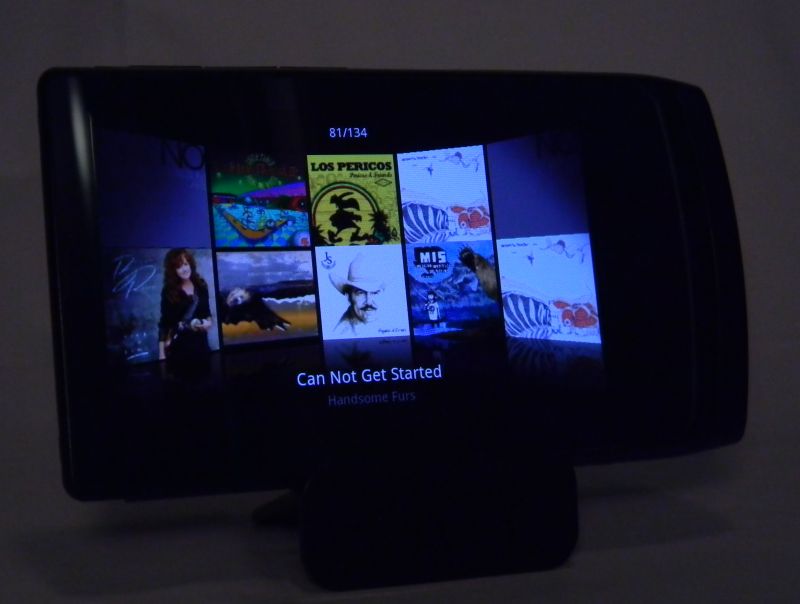
Lastly, When you tip the D3 on its side the display changes to a 3D-ish cover art arc. On this display you'll see the title of the current song, and your position number among the total number of albums. Tap on any visible cover to have it flip out and display the songs it contains (below). You can tap on any song you see listed to start playing it.  Tap the top bar of the list to flip back to the arc. Swipe left or right to rotate through all the albums.  You can turn this landscape display off in Preferences. When you do the Now Playing screen doesn't re-orient at all when the D3 is rotated.
This Music application is (almost) as thorough as the one on the J3. You can bookmark (press the D3's Menu button) any song from any list, and any position within a song.  The D3 doesn't do gapless playback.  I give Music an A-.  The sound quality is great when it isn't cutting out.  There is a need for on-board playlist/favorites creation or I'd give it an A+.

Video:  The D3 will play video formats including: AVI, WMV, ASF, MP4, MKV, MPG, DAT, TS, TP, TRP, and 3GP. Maximum resolution it will play is 1920x1080 (full High Definition), although not every resolution and audio and video codec combination up to that is guaranteed to play. It has played every video file I've thrown at it so far though. Those didn't include DAT, TP, or TRP files yet, as I have no sample files in those formats. VOB (DVD) files play if you change their extension from .VOB to .TS

You can resize many videos to fit the screen with a press on the screen or two.  Doesn't work if the videos have their own black bars. You can find videos by Folder or Thumbnail images or Bookmarks you may have previously set. The Thumbnail list (image below) adds video length to the info presented.  A long press on any movie file pops up more info, with Add to Bookmarks, Delete, and Details options.  Details will include the file name, file size, and resolution of the video.
Controls on the video Now Playing screen include AB marking, a play speed option (50% to 150% of original speed), and the usual play/pause FFwd/REW-next/previous buttons. The video title is displayed on the top edge of the screen.  Press the android menu button and you get several more options. Direct links to the list, details, and Add to Bookmarks are there, as well as Screen capture, AV-Out, and screen/subtitle settings.  Video play on the D3 gets an A+.  Better than on the J3 thanks to the larger screen size, higher resolution, and added codec support.
Pictures: The D3 will display your JPG, PNG, GIF, and BMP photo files on its beautiful AMOLED screen. The Photo app is typical Cowon.  Tapping on it you begin with the last Photo that was displayed. It will tell you the total number and position within that number of the photos in the current folder.  The big arrow in the upper right corner will take you to your photo list(s). Photos can be separated into folders, and folders can be selected individually. There is a nice slideshow feature with transitions and transition time choices.  You can manually rotate photos to best fit the screen, and they will also rotate when the D3 is itself rotated from landscape to portrait view or back.  Two-finger pinch or spread can be used to zoom out or in on details, and a double tap on the photo will also zoom in on it in steps.
Pictures can be used as contact icons or Wallpaper. Tap the photo to bring up the controls if they are not already visible.  Then tap the bottom right icon to get a pop-up window for the choices.  Now if only the D3 had a camera that contact icon feature would have been great.  As it stands, the Pictures app is fine.  Nothing overwhelming.  I'll give Pictures a B+.

FM Radio: The radio app is a welcome addition to the D3.  So far this is the only android-based  player I've got with FM radio. You'll need to have headphones plugged in to serve as antenna, and the radio will not output over bluetooth.   Options include auto-scanning for channels, Preset List, Add Preset, Preset Off, Start Recording, and Settings.   Under Settings you can set your region, and turn stereo on or off.  You also get an OFF switch.  I'll give Radio a B, as there is no RDS feature.

User Interface:  Cowon has decided they need to improve on the standard Android interface. It starts with a bottom bar that shows the available memory and amount left on the D3, next to a slider to switch between the Apps page (image below) and the home page. The left side of the bottom bar toggles between displaying the free space available, the number of running apps, and the day/date. The rest of the interface is rather normal for Android, with widgets and shortcuts and bookmarks as icons spread over 5 possible pages. On start-up the D3 wants to scan for new media you might have added, and it warns you that the system may not be responsive until it is finished.  There have been four firmware updates since I started writing this blog post, and with each the screen response and fluidity has improved. I have no doubt that Cowon will keep working on the D3 until its interface performance is on par with the iPod Touch. It is very close right now.
One thing I find annoying is the lock screen Cowon insists on using for the D3. My Archos Android players don't have it, and swipe-to-unlock is an unnecessary extra step in an otherwise competent execution.
On the good side, the D3 has external buttons for power/hold (image below), and volume +/-, play/pause, and FFwd/Rev (right side).  There are off-screen touch buttons for Back, Menu, and Home.
You can almost completely control media play without touching the screen.  A single press of the PLAY button will usually start playing music without unlocking the screen.  The power button will lock the touchscreen with one tap, turn the screen OFF with a quick double-tap, and bring up the power OFF option with a two second hold.
Bluetooth: I had no trouble pairing the D3 with my bluetooth headphones. I was disappointed to discover there is no gapless playback using bluetooth. Controls worked fine from the headphones or the D3, including volume. Additionally, in the Music app's preferences, you can turn off the headphone's ability to control the D3.  I tried pairing a bluetooth keyboard to the D3 and although it paired it reported there was no support for keyboards.  The D3 does support file transfers over bluetooth, but my first few attempts (with my PC and an Archos 43)  have failed after downloads got past 80%. I have succeeded since.  I'll blame it on the earlier firmware.  At this point bluetooth for headphones is still a little buggy.  I had the occasional cut-out or momentary freeze while listening to music, and I've never experienced the same on any other player. As such, Bluetooth gets a C+.  Hopefully it will improve with firmware updates.

Internet:  I had no trouble connecting to my home or work Wifi. The web browser works reasonably well, and multitouch zooming is greatly appreciated.  There is a slight response delay after tapping on any on-screen link. It is as if the screen sensor has to think for a second before responding.  Side-by-side with my iPod Touch the difference is notable. Scrolls are just a bit choppy on the D3 where they are smooth on the Touch.  The D3 will show more info on a screen than the iPod Touch as the Touch adds an options bar on every web screen.  The 800 x 480 screen is good, but not as crisp in detail as the Touch's 960 x 640 Retina display.  Many web pages recognize the Touch and reformat to a Mobile view for it.  The D3 usually gets a more typical PC page view on the same pages.  Double-tap and finger-spead to zoom both work as expected.   The web browser experience is better than on any lower resolution device, and better than any device without multitouch. It still isn't up to the standard set by Safari on an iPod Touch or iPhone, so Internet gets a B from me.

Apps:  No app store on the D3.  I've been able to side-load applications to my D3, and most have installed with no problem, the lack of an on-board market is a serious shortcoming Cowon needs to address.  Out of the box the D3 includes your typical music, video, pictures, and radio media apps.  You get email, web browser, YouTube, calculator (including simple and scientific versions), task manager, document (.txt) viewer, alarm clock, paint, voice recorder, calendar, contacts, comix, and twitter too. There are a few more apps on the Korean version of the D3 that disappeared when I installed the North American firmware.  Until either Cowon or hackers get a Market app working on the D3 I have to give it a C B for Apps.

Update 3/23/2011: Amazon.com has opened their Android Appstore now, and although the number of apps available is small you can expect it to grow exponentially. Easy to add their app to the D3.

Conclusions:  The D3 is a nice package with decent hardware and great potential. It has the power to drive my large Sennhieser headphones with authority. Music and Video codec support is the best you'll find. There are two reasons I won't recommend the D3 right now:  Price and maturity.  Amazon.com lists the D3 with 32gb of memory for $358.  A 32gb iPod Touch is $275. The new D3 is NOT $83 better than a new Touch.  The price is too high, even if every feature worked perfectly.   As I stated previously, Cowon has updated the D3 Firmware 4 times since I received it. It still exhibits random freezes, audio cut-outs, slow touch response, and no easy access to Android apps.   I assume Cowon will eventually resolve these issues, but right now the D3 performs worse than my old HTC Hero Android phone. Cowon needs more experience with Android.  Hopefully they are learning fast, as the D3 is not quite ready for prime time.

2/10 EDIT:  Cowon updated the firmware on 2/10/2011 to version x.27.  I've installed 3.27 on my D3, and the audio cut-outs I mentioned seem to have been eliminated.   Still no gapless playback, and no apps store.

4D.

P.S.  If you appreciate my blog, please consider clicking on one of the ads.   Thanks! 

Wednesday, November 10, 2010

Archos 43 with Android. My Review!


Image from Archos.com

Hints of the new Archos 43 media player caught my attention the last month or so. From the early press releases it seemed like the one to get.   It is now available, so I ordered one to see if it would live up to the specifications.  The name gives away the display size, as it has a 4.3" (diagonal) screen with 480 x 854 pixels and 16 million color support.  All the basic underhood technology seems there with WiFi and Bluetooth, Accelerometer, Camera, a graphic accelerator, and Android Froyo 2.2 (soon) as the operating system. I've been tricked by specs from Archos before.  Will the 43 be any different?  It is a beautiful beast with a mirror-finish back to compliment the big glass front.  Very sturdy, with an overmoulded stainless steel interior structure.
Archos didn't leave much out when they built the 43. The missing GPS and 3G (phone) chip are the only things that keep the 43 from being a smartphone.  Some hardware specifics below.
 
- External Controls:  You get a volume level rocker and a power/sleep/reset button.  That's it.
- Ports:  MicroUSB for syncing and charging, a mini-HDMI  port, and the expected 3.5mm headphone jack. You'll need a mini-HDMI to HDMI cable to connect to a TV.  About $10 if you shop around.
- RAM:  16gb internal (roughly 14.3gb for your use).  A MicroSD-HC slot on the side for up to 32gb more.  Media on the microSD card is merged with any internal media, and shows up together in the media apps. The Files program lets you browse content on both the internal an microSD memory.  
- Wireless:  WiFi (802.11 b/g/n) and Bluetooth (2.1 EDR)
- Display:  Single touch (not multi-touch) screen, resistive (pressure sensitive), 480x854 pixels (FWVGA), 4.3'' TFT LCD, 16 million colors
- Dimensions:  135 x 65 x 9 mm – 5.3” x 2.6” x 0.4”
- Weight: 132 grams (4.65 ounces).  For comparison my new iPod Touch weighs 103 grams (3.63 ounces)
- Kickstand (Fold out leg stand)
- Speakers: Above and below the screen. Mono output however.  Sound good. Better than most phone speakers.  Not as good as most headphones. 
- Microphone: Should do fine when shooting video. There is also an included voice recording app.
- Camera:  2 MP - recording format: 720p H264 / AAC .MP4.
Sample taken from the 43.
The camera is best used holding the 43 upside down IMO.  I can confirm that it isn't good enough to use with barcode scanning apps. I tried three different barcode scanning apps, and none could focus well enough on any barcode I tried to decode it.  No autofocus or macro mode.  This isn't as good as most cheap pocket cameras.  Video would be best take outdoor and on a tripod if the 43 had such a tripod mount.
This is at best a token feature. It may come in handy when no other camera is available, but I wouldn't buy the 43 just for the camera feature.  You'll be disappointed.  Camera gets a C from me.

- G-Sensor: Works as expected. Detects screen orientation. The Whole UI will re-orient quickly unless turned off.  You can turn it off in Settings.

- Bluetooth: I've had a chance to check out the Bluetooth capabilities now. I succeeded in pairing with and using my Freedom Pro keyboard with the 43. I had an initial conflict when both WiFi and Bluetooth were turned on, but a reboot cleared it up and the keyboard was usable entering text in any app that required it, including the web browser, email, and the trial document editor that came with the 43.  I also was able to pair three different Bluetooth headsets and one Bluetooth speaker dock with no difficulty.  There was the occasional signal glitch. I believe it relates to WiFi being on and email notices distracting the 43's attention. I couldn't get it to reliably repeat though, and I was able to use the bluetooth keyboard, listen to music over bluetooth headset, all while browsing the web or sending emails.  I have no doubt a bluetooth mouse would also work, but don't have one to test. I was able to do a file transfer over bluetooth using a dedicated app for that purpose, as well as "bump" a contact to my cell phone using the Bump apps on both devices via bluetooth. I give bluetooth on the 43 an A.

From Archos you can expect complete Music, Video and Photo Players.  These are NOT the standard android media applications.

- Music: Supported formats include Stereo MP3 CBR & VBR,  WMA, WAV (PCM/ADPCM), AAC3, AAC+ stereo audio files, OGG Vorbis,  and FLAC. It will also play consecutive song with no audible gap in between.  The display rotates with the device, and you'll get larger album art playing vertically, or the now playing song can fill a screen with it's art.  You can sort by albums, artists, songs, playlists, or by folders.  Sorting a large collection of songs brings up a thumb tab that when used displays the alphabet as you pan up and down through the list. Songs from the microSD card are integrated with any songs that are on internal memory.  You also get a nice cover roll of the recently played album songs. You can add to playlists or favorites.  There is a Party Shuffle option.  Very detailed Info is available about any song, album, or folder.  As far as I can tell the only shortcoming of the Music app is the lack of sorting by genre. As such, Music gets an A from me.
Music playback time: up to 36 hours.

- Video: AVI (480 x 272)(720 x 404) (320 x 240), WMV (1280 x 720)(720 x 416)(540 x 360), MP4 (1280 x 720)(640 x 480) are the resolution and codec I was able to play with no trouble on the 43. Nothing larger than 720p would play. The video player gives you all the info that matters. Simply listing the files there are options for All Videos, Recently Played, Not Player Yet, and Folder Search. You can browse for and play videos on locally accessible network shared folders as well as media servers.  Fast-Forward/Rewind and relative positioning within a file are both supported. You can call up detailed file info, set bookmarks, resize video to fit the screen or not, and adjust brightness. A Settings sub menu also provides Play mode, Sound, and volume/title display toggles. Play mode lets you choose Single, Folder, Repeat Single, or Repeat Folder options. Choosing Folder lets you play in sequence all the videos the same folder.   Sound options include setting the EQ Presets, Bass, Treble, 3D, and L/R Balance of the audio output.  You can send video out through the (optional) HDMI cable to a big TV too!  Video playback get an A+ from me.
Video playback time: Up to 10 hours.

- Photo Gallery: JPEG, BMP, PNG, and GIF files can be displayed. You get a panning array or sorted group view of the available photos, both using the creation date of each photo to sort by. In the arrayed view the entire collection is show by date from left to right, with the dates appearing as you use the slider bar to move over the group. Once you've selected a photo, zooming is great. Zoom in to what appears to be one-to-one pixels displayed on the screen. Smooth Pan and Zoom is easily handled by the graphic processor. You can zoom in five steps to full resolution, or double-tap the screen to zoom all the way in/out instantly. You can slide show with transitions and music in the background. All the basic features seem to be there.  You can crop, rotate, Set as (contact icon or wallpaper), You also get a SHARE option with sharing via Bluetooth, Email, Touiteur (Twitter), Facebook, or Gmail, shown as well as any other choice related to apps you may have installed.   I'll give Photo viewing an A.
- Web Browser: Web surfing: up to 12 hours on a battery charge. A double-tap on any web page paragraph enlarges it to fill the screen. There are several "Favorites" already stored for you, and you can add your own page to the favorites/bookmarks page.  Not quite as nice as the Safari browser on the latest iPhone or iPod Touch, but easily second best.  I've seen far worse browsers. This web browser gets a B+.

- App Store:  There is a decent selection of applications already on the 43. They include Webbrowser, Email, Contacts, Appslib, Twitter, Wikipedia, Weather Channel, Ebuddy, Deezer, Mewbox (UK), Napster (US), Racing Thunderlight, Weather Channel, World Newspaper, and more.  The Appslib program gives you access to hundreds of other applications.  A search on the web will find you can also add the Google/android market app as well, which gives access to almost every other android app out there.  A+

UI: The screen reacts quickly to the touch of your finger or a stylus.  Graphics flow smoothly, and there are five home pages to layout anyway you want.  Add widgets or shortcuts.  Arrange them anyway that makes sense to you.  Delete apps you don't have a need for.  I found that using my thumb isn't the best at controlling the screen, but any other finger works fine.  This may be peculiar to just me and not you. I love that the whole UI and most apps will re-orient themselves as you rotate the 43.  You can change screen brightness. You can turn on or off any audible alerts or notices.  This is as good as any other android device I've used, and better than many. I give the UI an A.

Conclusion?   Archos has a winner here. I highly recommend this to anyone who want a better media player than an iPod, yet doesn't want to give up the apps store or web browsing that come with WiFi. Now to find a case for mine.

4D

Tuesday, April 27, 2010

Google's Android Tablet

I have no idea what it will look like. All I know is that it should have some original product design time spent on its looks to be competitive against all the other tablets we'll see this year. Hopefully the Android market will start seperating apps into those for phones with relatively small screens and those that take advantage of higher resolutions. Then use a Tegra 2 or even Creative Labs Zii processor in it for quick performance and low power consumption.

More later, when it actually shows up.

4D

Saturday, October 31, 2009

Archos 5 Internet Tablet with Android. My Review

Now that Archos put Android on one of their touchscreen monsters I thought it was worth a look. The Archos 5 Internet Tablet (with Android) comes in 8gb (Radio Shack), 16gb and 32gb flash memory models, as well as 160gb and 500gb hard drive based models. The 500gb model is roughly $500 and a great deal per gigabyte. I don't have any need for that much space so I picked up the 32gb version. The flash memory models are thinner and have a microSD slot for add-on storage.

Dimensions: 143.2 x 78.8 x 10.4mm. Mine weighs 182 grams (6.4 ounces). The Screen is 800 x 480 pixels, 4.8" TFT LCD, 16 million colors. There is a nice little fold-out stand which holds the 5 up at a great viewing angle.
Source: BHPhotoVideo.com. Amazon.com and Newegg.com have them as well. Typically $380 for the 32gb model.

Media play includes:
- Music: MP3, WMA, WAV, AAC, OGG, FLAC. Up to 22 hours. Gapless play seems to be there, at least with the MP3 files I've tested. - Video: MPEG-4 HD (up to 720p), MPEG-48 (ASP@L5 AVI, up to DVD resolution), H.264 HD (up to 720p), WMV (MP@ML, up to DVD resolution) including WMV protected files, MKV (up to 720p, 2500kbs, 23fps), M-JPEG (Motion JPEG Video) in QVGA resolution. Up to 7 hours. - Photos: JPEG, BMP, PNG, GIF- Flash Games
- FM Radio (with RDS). You can find it after tapping on Music. I'd love to have a dedicated icon for it but haven't figured that out yet.

Media Input includes:
- Voice Recording with the built-in microphone.
- Stereo Line-In recording with the optional DVR Station or DVR Snap-on.
- FM radio recording.
- Video Recording with the optional DVR Station or DVR Snap-on.
·
Radios:
- Wifi including 802.11b, g, and n.
- Bluetooth for wireless headphones and more. Bluetooth keyboard and mice work too.
- GPS for Navigation and location sensing (Google Maps).
- FM Transmitter.
·
Other:
- G-Sensor
·
Apps: I'm not going to list or review them here, but you can find a list at Archos.com. Many rely on you subscribing to their associated web sites. Email and contacts are there thankfully. You can also find many more apps and download them directly to the 5 using the AppLib application on the 5. The User Interface: Sensitive and reliable. Some actions take awhile to process and that can make you think the UI is sluggish, but once you are at the Home Menu or within the photo app you'll see there is plenty of horse power for smooth graphics and quick response when it is most important. The body has only three external buttons. Thankfully they included VOLume Up and VOLume Down along with the Power button.
Quality: As a media player this Archos has what it takes. Music, Video, and photos all take advantage of the hardware, sounding and looking great. Using Wifi you can also access shared folders on your home network to find far more than you might have stored locally on the 5. As a pocket computer the 5 is not completely there, but it's got the tools to improve with firmware updates. Support for a bluetooth keyboard and network printer would be all that's needed to eliminate one's need for a notebook PC. The 5 tends to attract fingerprints front and back, but so do most touchscreen devices I've tried. Seams between body halves are a little sharp. The built-in stand is a nice touch and is mounted stiffly enough to be adjusted to variable viewing angles. It will also prop the 5 up on it's right end but the 5's rounded end makes for a teetery perch.

·
Conclusion? My Archos 5 is growing on me every day. So far the software has updated itself twice. It now runs on Android 1.5, and version 1.4.25 of the Archos firmware. While pricey, you are getting the largest screen that will still fit into a shirt pocket. There doesn't look to be too much the Archos 5 won't run eventually. It might be an amazing value in a year. At the moment though it is incredible but pricey.
·
4D